
What is VisDeck?
VisDeck is a physical card deck for designing information visualizations. Instead of guessing which chart to use, you build a visualization by placing cards on a table: each card represents one design decision — the question you're answering, the data you have, the visual marks you'll use, and how you'll encode values in those marks.
Cards connect through a port-and-symbol system printed on their edges. If the symbols don't match, the design is invalid — the cards tell you before the instructor does.
Your goal is not to find the right chart. It is to build a design you can explain and defend: What am I trying to see? How am I encoding the data? What does this reveal? Why is this a good choice?
During evaluation, you walk through your card layout with the instructor. What matters is the quality of your reasoning, not the chart you chose. Playing a risky technique and explaining the trade-offs well demonstrates more skill than playing a safe chart with no justification.
The Deck at a Glance
The deck contains 155 distinct card designs across 10 categories. A few high-demand cards — Position, Quantitative, and Categorical — include extra copies for multi-channel and multi-attribute configurations, bringing the physical deck to 160 cards.
Anatomy of a Card
Every card in the deck follows the same visual structure. Here is a Technique card (Pie Chart) as an example — it has all the key elements, including a warning triangle. Other categories use the same anatomy, though their sections and ports differ.
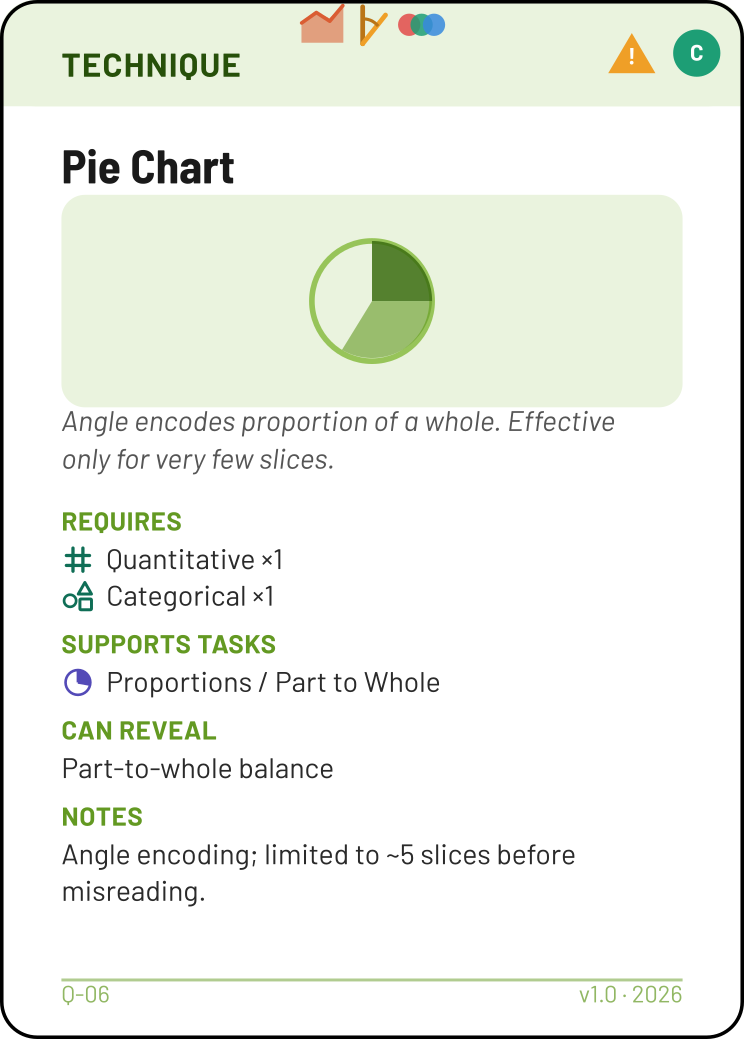
Top-edge ports
Connection points along the top edge. On this Technique card, they show the required Mark + Channel combination (Area + Angle + Color Hue).
Category strip
Coloured band identifying the card type — Task (purple), Attribute (teal), Mark (coral), Channel (amber), Technique (green), and so on.
Warning triangle
Amber triangle with "!" (when present). This card requires a specific Principle card to be legally played — see Warning Cards.
Rarity pip
Filled circle showing the rarity tier: C Common, U Uncommon, R Rare, M Mythical.
Card name
The card's title — a task name, attribute type, mark type, chart name, etc.
Icon
Visual representation of the concept on a tinted background.
Description
Brief italic text explaining what the card represents.
Body sections
Structured information specific to the card type — required attributes, supported tasks, accuracy rank, notes, etc. See Reading Card Sections for details.
Footer
Card ID (e.g. Q-06) and deck version number.
Curious? Check out the [VisDeck Project Website]{https://visdeck.tecnico.ulisboa.pt/} for details, rulings and playthroughs.